
By Sarah Cipes (2021 PRC Fellow, IGS Digital Arts & Humanities PhD candidate)
First, there are some things you need to know about humour theory (or ‘humor’ theory – I got used to the conference organizers’ use of American spelling). There are several possible theories for why humor causes laughter. The most widely accepted of these is the incongruity theory, in which a statement or action goes against a societal norm or factual consistency, and the surprise of this incongruency causes us to laugh. Incongruous is an excellent way to describe my experiences at the International Humor Society Conference in Kraków, Poland this July, 2025.
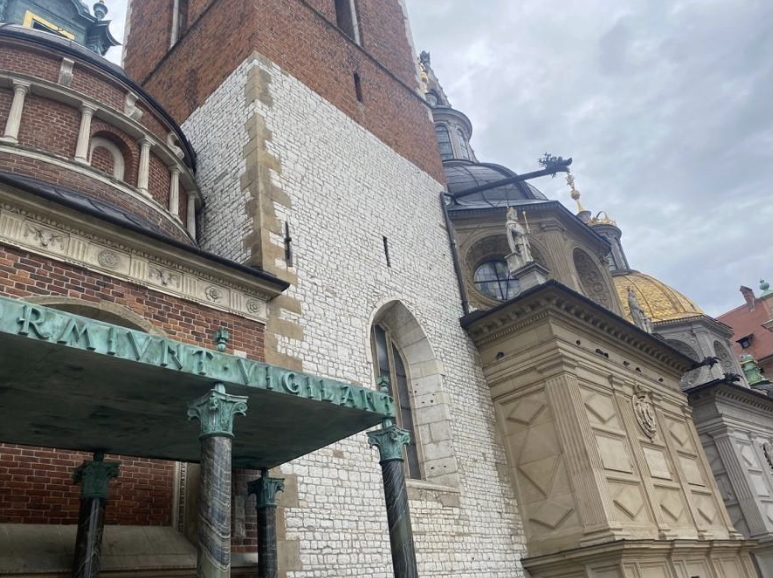
Kraków is a wonderful and mysterious place. The Wawel Castle in the city centre showcases the forcing together of several different architectural styles, with each monarch adding their own piece to the entrance, with apparently no concern for visual coherence. I found this type of juxtaposition throughout the whole city; neoclassical buildings covered with contemporary graffiti were everywhere. The terracotta shingles on the roofs of gothic revival buildings were topped with solar panels, soaking up the uncharacteristically sunny weather that Poland had while I was there.

Similarly, the international society for humor studies is in some ways a juxtaposition. Academia and humor can seem at odds with one another – Aristotle’s writings on the importance of drama (and, in contrast, the frivolity of comedy) continue to echo through our preconceptions of scholarly work to this day. But, as the conference’s many researchers, scholars and presenters proved, humor is indeed a serious business.
Major themes throughout the conference included humor from a philosophical standpoint, humor and religion, humor and AI, the study of stand-up comedy, humor as a tool in political struggles, humor as an educational tool, and humor theory writ large. There were more topics, and some of them were separated with more granularity, but were I to list everything precisely, I would probably be testing your patience. If you’re interested, you can find all of the topics and abstracts on the International Society for Humor Studies Conference site here.
Two themes especially stood out to me about many of the presentations. The first was the seriousness with which humor is studied. Considering what I’ve learned from fellow presenters at this conference about humor as a political and social weapon, humor certainly should be taken seriously. The second was the value of bringing a variety of interdisciplinary approaches to the study of humor: contemporary political humor viewed through feminist and computational lenses; stand-up comedians being researched by lawyers and philosophers in tandem; and, humor as a recruitment tool through the lens of education and gender studies are just some of the transdisciplinary and interdisciplinary studies I noted at the conference. I also heard excellent presentations about the history of comedy as political intervention and looked at websites created to collect and showcase these interventions. In other cases, quantitative data was used to show why we laugh, how politicians use jokes on social media, and why large language models are still absolutely trash at generating anything resembling a valid joke (thank goodness). In case you were wondering, the answer is no: however illuminating they may be, there is nothing funny about numerical data tables.
As a scholar-practitioner of stand-up comedy, a PhD candidate in the Interdisciplinary Graduate Studies program (Digital Arts & Humanities Theme), and a research associate in the AMP Lab, I regularly locate my work within an interdisciplinariy context, with a particular focus on literary audio studies. But as the only researcher at the conference using tools generally reserved for sound scholars – such as Drift4 – I was concerned that my work would not build on the practices at play in the humor studies community. As it turned out there was no need to worry. Through discussions with humor scholars, I found my research affirmed by prior studies in adjacent fields – particularly work dealing with the prosodic aspects of humor, while bringing in new computational tools and the framework of auto-ethnographic study. It was exciting to find an academic community that connected with this aspect of my research — there were other humor practitioners there, and no one was studying humor because they didn’t want to laugh.
Working with and speaking to other members of the International Humor Society, I began to feel my own personal sense of incongruity lessened. I connected with humor scholars about shared experiences, made a list of the vast numbers of books and articles I still need to read, and met folks similarly using academia and computational tools, at least in part, as an excuse to take part in humor (i.e. do improv, make jokes, watch other people making jokes, and most importantly, to get to talk to other people about what we observe and do). Humor can create and dismantle hierarchies, solidify relationships, and can even be used as a force for oppression. It deserves to be studied and understood with as much vigor and focus as any other human creation.

Before I end, I want to thank Dr. Diana Solomon and Sean Zwagerman of SFU and my Ph.D. Supervisor Dr. Karis Shearer, all of whom provided mentorship and funding that supported my travel to the 35th International Society of Humor Studies Conference. It was truly a life-changing experience.